
Wired for This: Neurodivergent Minds and the Workforce That Wasn’t Ready Chapter 2: A System Built for a World That No Longer Exists
Before there was a diagnosis, there was a classroom.
And before the classroom, there was a decision, made by people who are long dead, about what a child’s mind was for.
That decision has shaped more of your life than almost any other single factor. It shaped what you were rewarded for and what you were penalised for. It shaped what counted as intelligence and what counted as disruption. It shaped the version of yourself you learned to present, and the version you learned to hide. And if you are a late-diagnosed neurodivergent adult reading this, there is a reasonable chance that the classroom, far more than any neurological difference, was where the mismatch between your mind and the world around you first became visible.
Understanding where that system came from, and what it was designed to do, is not a historical exercise. It is the beginning of understanding why so many capable minds have spent so long being told, in one way or another, that they are not enough.
Where Mass Schooling Actually Came From
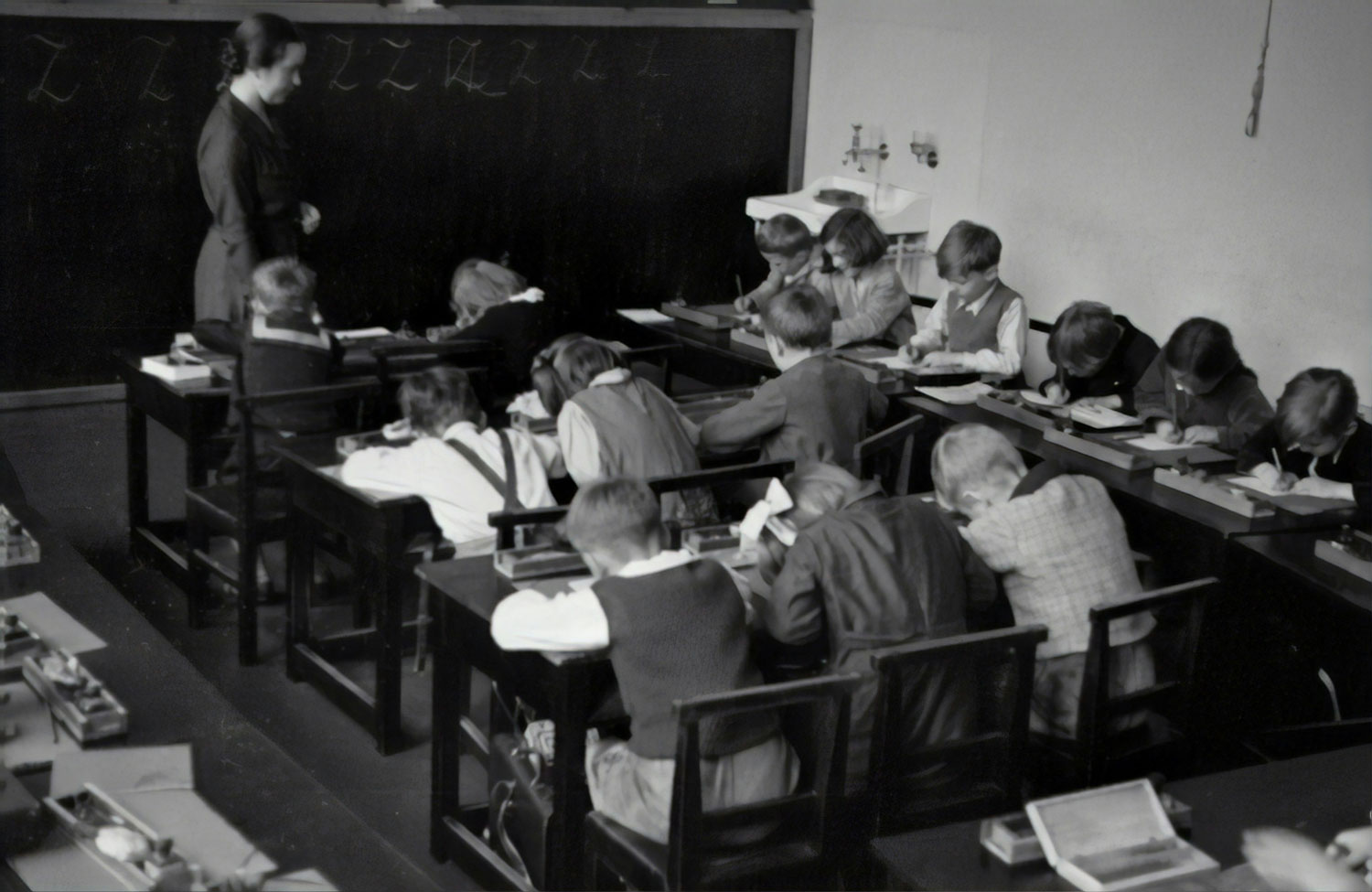
The structure of modern compulsory schooling, the age-graded classrooms, the bells, the standardised curriculum, the single teacher addressing rows of students, was not invented gradually or organically. It was designed. The clearest model comes from Prussia in the early 1800s, where the state created a compulsory, state-run school system with a specific and explicit purpose: to produce loyal, literate, governable citizens. Prussia had recently been humiliated militarily by Napoleon, and its leadership concluded that national survival required a unified, educated population that would follow instructions, identify with the state, and show up when called.
It is worth being honest here, because the “factory school” narrative is popular and is sometimes overstated. The Prussian model was not primarily designed by industrialists, and it predates the full industrialisation of Europe by several decades. Its original purposes were civic and military rather than commercial. This distinction matters because it changes the nature of the critique. The design was not primarily about producing cheap labour, though it served that purpose as economies industrialised. It was about producing a particular kind of person: one who could function reliably within a large, hierarchical system, follow external authority, and perform consistently regardless of individual variation.
That framing should sound familiar to anyone who has spent time in a school built on that model.
As the 19th century progressed, industrialising economies across Europe and North America adopted and adapted the Prussian template. The fit was convenient. Factories and bureaucracies needed workers who could read basic instructions, perform repetitive tasks with consistency, arrive on time, and accept the authority of a supervisor. Schools that produced punctual, rule-following, uniformly assessed graduates were a reasonable production line for that workforce. The bells, the age-cohort progression, the emphasis on standardised output and measurable compliance, these features were not accidental. They were logical for a world that needed human beings to function reliably and interchangeably within large, fixed systems.
The historian David Tyack, writing about the American version of this model, called it “the one best system,” capturing how thoroughly the industrial era school standardised itself across a diverse population. Though his analysis was specific to the United States, the dynamic he described, the drive toward administrative uniformity at the expense of individual variation, was common across most Western education systems of the same era.
What the System Selected For, and Against
This is the part that matters most for where this series is going.
A system designed around compliance, uniformity, and standardised output is not neutral. It selects for certain kinds of minds and against others. Specifically, it rewards minds that can sit still for extended periods, shift attention on a bell’s command rather than on the logic of a task, produce consistent output under external evaluation rather than internal interest, tolerate repetitive work without losing focus, and read social hierarchies accurately enough to know when to be quiet.
These are real cognitive skills. They are also, it is worth noting plainly, not the cognitive profile that research now associates with ADHD or autism. Inattention that tracks interest rather than instruction, difficulty disengaging from a task that is not yet finished, sensitivity to sensory environments, a different relationship with social authority, the tendency to question the logic of a rule rather than simply follow it, none of these are deficits in the abstract. They are differences. But inside a system optimised for a specific cognitive profile, a difference from that profile will consistently register as failure.
This is what researchers now call a neurocognitive mismatch, not a flaw in the person, but a mismatch between an evolved neurocognitive style and the institutional environment in which that style is required to operate. The concept draws on the social model of disability, which distinguishes between impairment (a biological difference) and disability (the barriers constructed by society around that difference). Neither ADHD nor autism necessarily creates disability in every environment. They reliably create disability in environments designed around a narrow set of cognitive norms, which is exactly what the compulsory classroom was.
This is not a conspiracy. The designers of mass schooling were not targeting neurodivergent children. Neurodivergence as a concept did not exist. What they were doing was something more ordinary and in many ways more durable, they were building a system around an implicit assumption of what a normal child’s mind looked like and optimising everything for that assumption.
That assumption has never been formally rescinded. It has simply been inherited.
The Long Tail of a 200-Year-Old Decision
Today’s classrooms are not identical to their 19th-century predecessors. Curricula have expanded, teaching methods have diversified, and most systems now make at least formal provision for students with identified additional needs. In Ireland, the Education for Persons with Special Educational Needs Act has been in place since 2004. Across the UK, special educational needs frameworks have been repeatedly revised. The language has changed.
What has changed less is the underlying architecture. The bell still rings. Students still move through age graded cohorts at a standardised pace. Assessment still measures performance against uniform criteria. The implicit norm of the system, the kind of attention, the kind of focus, the kind of social behaviour that is rewarded as default, is still recognisably descended from the model built two centuries ago for a purpose that has long since ceased to exist.
For neurodivergent students, this creates a specific, often invisible problem. The system does not typically present itself as being designed against them. It presents itself as neutral. As the normal way of doing things. So, when a child persistently fails to meet its expectations, the most available explanation is not that the system was built for a different kind of mind. It is that something is wrong with the child.
Many of the adults now receiving late diagnoses of ADHD and autism spent their entire school years carrying that explanation. They were disorganised, or difficult, or bright but not working to their potential, or socially awkward, or distracted, or too intense, or too sensitive, or simply, in the word that follows so many neurodivergent people into adulthood, too much. The system was not designed to offer any other interpretation, because the system was not designed with their mind in view.
And all of this happened before they ever reached the workforce.
Iris Walshe is an AuDHD equestrian athlete, ADHD/AuDHD coach, and founder of NeuroWave Coaching. She has competed across showjumping, eventing, and dressage, and holds ADDCA, PAAC CACP, and ICF credentials. She works with neurodivergent athletes and high-performing adults at neurowavecoaching.com.
References
Tyack, D. (1974). The One Best System: A History of American Urban Education. Harvard University Press. Referenced for the historical framing of standardisation in industrial-era schooling.
Doyle, N. (2020). Neurodiversity at work: a biopsychosocial model and the impact on working adults. British Medical Bulletin, 135(1). Referenced for the neurocognitive mismatch and social model framing. Note: this is a literature review paper; no original prevalence data is attributed to it.
Government of Ireland (2004). Education for Persons with Special Educational Needs Act. Referenced for Irish legislative context.
Historical note for readers: The characterisation of the Prussian-origin school model in this article reflects a well-established body of educational history. The “factory model” framing, while widely used in education reform literature, is a simplification. The original Prussian system predated full industrialisation and was designed primarily for civic and military purposes. The connection to industrial workforce needs developed as economies changed, not as an original design intent. Where this article draws interpretive conclusions rather than citing specific studies, it is doing so on the basis of historical consensus rather than a single empirical source.
Image : Austrian National Library / Unsplash